


Jul 14, 2026
Module mmWave V4.0: Major ESR Enhancements and Full FR3 Support for 5G-Advanced and 6G
SPEAG has released DASY8 Module mmWave V4.0! With full support for 5G-Advanced and 6G frequency range 3 (FR3), the fully revised module delivers stable, accurate, and faster equivalent source reconstruction (ESR) – also valid for evaluations in the extreme near-field – while adding Multi-TX exposure analysis and over 5,000 new signal entries.
Faster Equivalent Source Reconstruction
A newly developed, advanced finite-element-inspired ESR algorithm reconstructs incident power density (IPD) from electric field (E-field) measurements and has been extensively optimized to provide fast, accurate, and reproducible assessments across the 6–110 GHz frequency range.
Compared to Version 3.0, DASY8’s updated implementation reduces typical computation time by a factor of 5, enabling substantially faster post-processing while improving reproducibility. The algorithm has been validated with more than 3,000 simulated measurement configurations covering a wide range of antenna types, operating frequencies, and measurement distances.
Multi-TX Evaluator
Modern wireless devices transmit simultaneously across multiple frequency bands. Module mmWave V4.0 introduces a Multi-TX evaluator that combines individual transmitter measurements to calculate the resulting peak spatial-average IPD (psIPD).
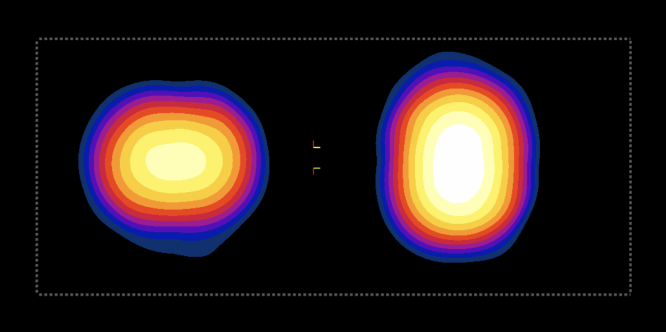
Combined sIPD distributions on a virtual flat phantom
The software also supports the export of spatially averaged IPD (sIPD) distributions in CSV format for total exposure ratio (TER) evaluations. Standard spreadsheet software can be used to combine the exported data with spatially averaged specific absorption rate (sSAR) results from DASY8 Module SAR V18.0 in accordance with TER calculation rules.
An automated TER evaluation tool based on the DASY8 application programming interface will be released in a future update.
Expanded Signal Database
DASY8 Module mmWave V4.0 extends its signal database with more than 5,000 additional 5G NR and Wi-Fi 7 signal definitions.
For advanced users, a new expert mode allows custom signal generation from just four easily measurable parameters, simplifying the evaluation of early 6G prototype devices before formal standardization.
The graphical user interface has also been modernized with improved search capabilities, advanced filtering, and a streamlined workflow for selecting and managing signals.
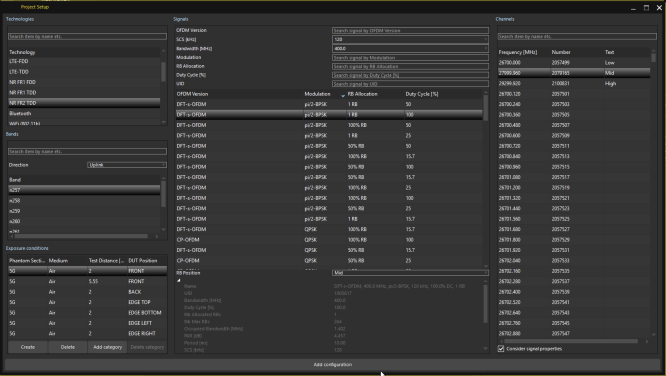
The new signal database in DASY8 Module mmWave V4.0 includes over 5,000 new signals
For more information, please contact info@speag.swiss.


